


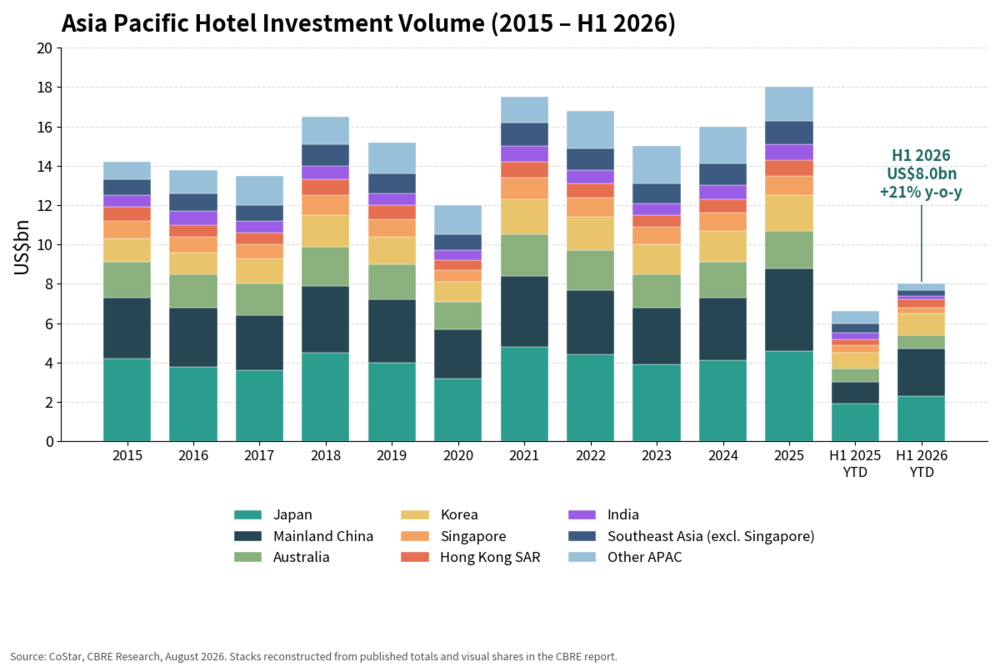
Asia-Pacific hotel investment accelerated in the first half of 2026 as resilient travel demand, rising room rates and a shrinking development pipeline strengthened the sector’s appeal to investors, according to CBRE.
Hotel transactions reached about $8 billion in the six months through June, 21% above the year-earlier period, with Japan, mainland China and South Korea leading activity. Mainland China posted the sharpest rebound, with investment volume more than doubling from a year earlier, helped in part by the expansion of China’s real-estate investment trust framework to include four-star-and-above hotels.
“Hotels have become one of the most compelling real estate investment sectors in Asia Pacific,” Steve Carroll, CBRE’s head of Hotels & Hospitality for the region, said in the firm’s 2026 Asia Pacific Hotels & Hospitality Performance & Outlook report.
The investment surge comes as hotel operating fundamentals improve across much of the region. Average daily rates, or ADRs, have reached or approached record levels in many markets, while revenue per available room, or RevPAR, continues to rise, primarily because operators have been able to push rates higher.
South Korea and Vietnam stand out on both pricing and occupancy. Korean ADR was up 13% year over year through July, while Vietnam’s increased 12%. Occupancy in the two markets also rose 7% and 8%, respectively, and both have moved above pre-pandemic levels, according to CBRE.
The broader tourism recovery has been more uneven. International arrivals increased in most Asia-Pacific markets during the first half, but disruptions to long-haul air routes linked to the Middle East conflict, combined with higher aviation fuel costs, have constrained capacity. CBRE cut its 2026 forecast for Asia-Pacific passenger-traffic growth to 5.1% from 7.3% previously.
Changing travel patterns have benefited some markets. Vietnam recorded a 56% jump in European visitors during the first half after expanding visa exemptions, improving air connectivity and increasing promotional efforts. South Korea’s international arrivals rose 20%, supported by demand associated with its cultural industries and medical tourism.
Japan has seen a different shift in its visitor mix. Arrivals from mainland China fell 56% through June, reducing their share of visitors to 10% from 22% a year earlier. Growth from South Korea, Taiwan, Europe and the Americas helped offset part of that decline.
At the same time, high construction and financing costs are limiting the amount of new hotel stock coming to market. CBRE expects Asia-Pacific hotel supply to expand at a 2.3% compound annual rate from 2025 through 2029, less than half the 5.1% historical rate. Mainland China accounts for 49% of projected additions; excluding China, supply growth is expected to be only about 1% annually.
That scarcity is pushing investors beyond traditional ground-up development. CBRE said owners are increasingly pursuing repositioning and adaptive reuse, including hotel conversions into other forms of accommodation. In Hong Kong, nine hotels totaling about 1,600 rooms traded in the first half for conversion to student housing, compared with two such deals a year earlier.
“New hotel development remains challenging across much of Asia Pacific due to elevated construction and financing costs,” Ada Choi, CBRE’s head of Research for Asia Pacific, said. Investors are therefore seeking to unlock value through repositioning and conversion, she said.
CBRE expects hotel fundamentals to continue supporting investment in the second half of 2026, while warning that elevated borrowing costs in some markets could constrain returns and temper transaction growth from the first-half pace.

 English